
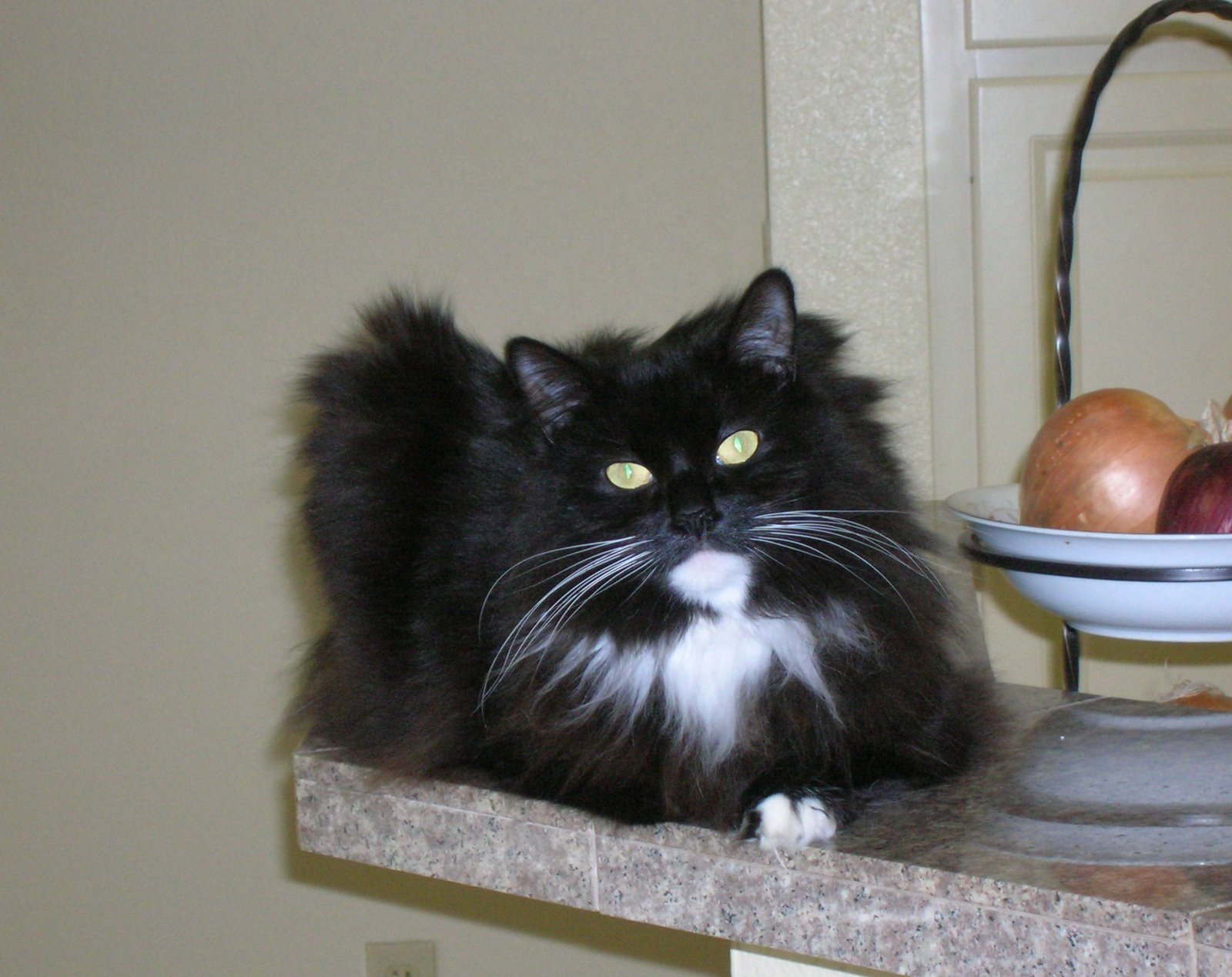
 We first met Muffin in April of 2006 at Purrfect Pals. All we knew is that she was found on the streets of Everett, Washington. She was about a year old. They called her a “medium hair” cat which was eventually shown to be an understatement. She was a beautiful kitty, very affectionate, well behaved (she only scratched on designated scratching posts, she didn’t get into things, etc). She didn’t get along too well with our other cat, Freya, but they reached a truce only interrupted by an occasional hiss (from Muffin) or a brief chase.
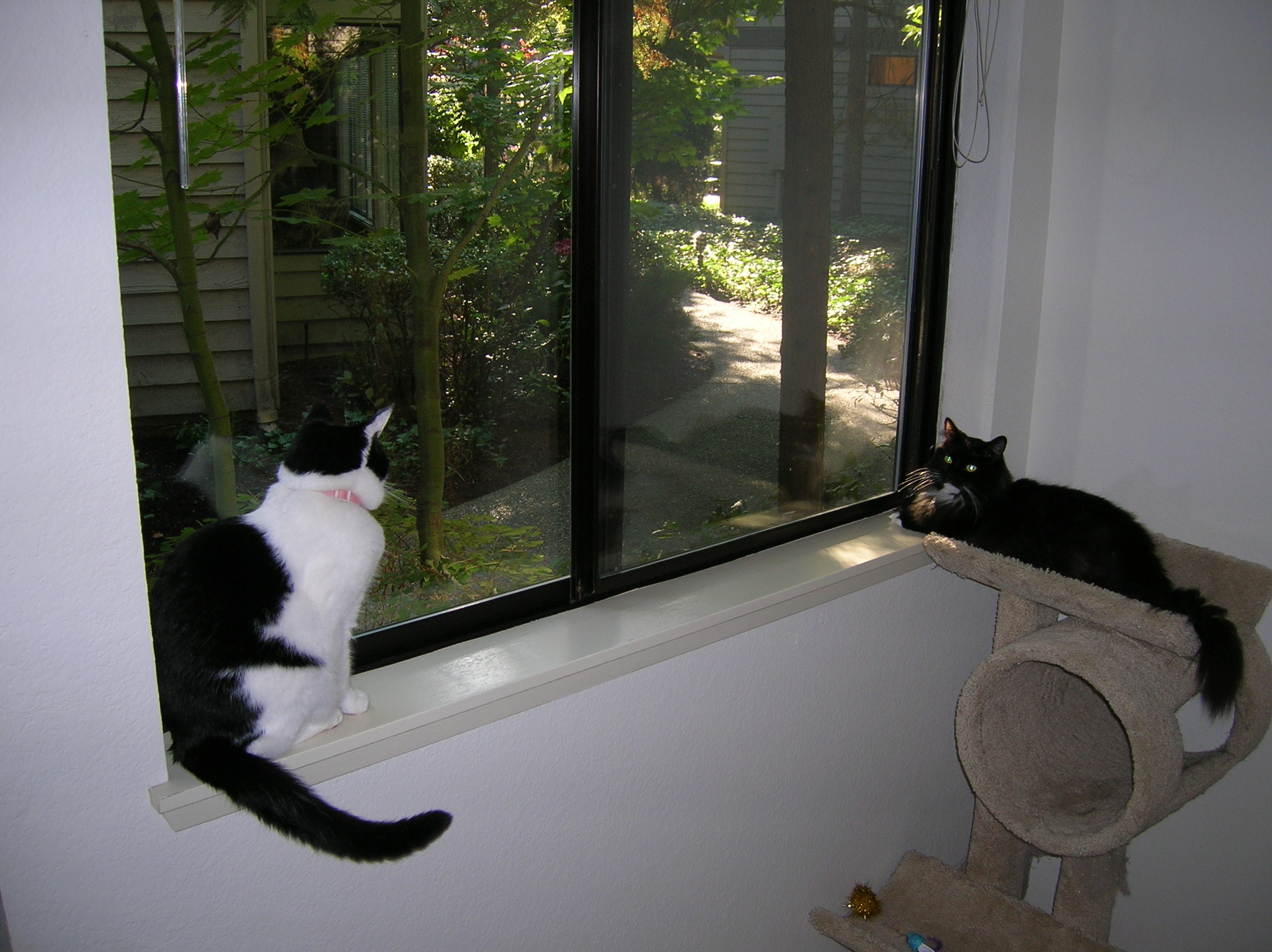
In July she started hiding under the bed and was very testy. Something was definitely wrong, so we took her to the vet. After some examination and X-rays we found she had two pins in her back leg (which had to be removed). Someone spent a lot of money to fix her broken leg. This deepened the mystery of her origins. She wasn’t just a stray, someone cared deeply for her. How did she end up on the street? Here’s my theory/story: an elderly woman bought a cute long-haired kitten. At some point she broke her leg and was treated (at no small cost, to be sure). The woman then passed away, and her children, while cleaning out her house, left Muffin outside. Perhaps intentionally, but Muffin was pretty scatterbrained so it is plausible she had wandered off and came back to find a locked and empty house. I am sure she innocently wandered up to any humans she could find, meowing at them for food and attenion. One of them dropped her off at the Everett shelter. From there she was picked up by Purrfect Pals, and the rest is history.
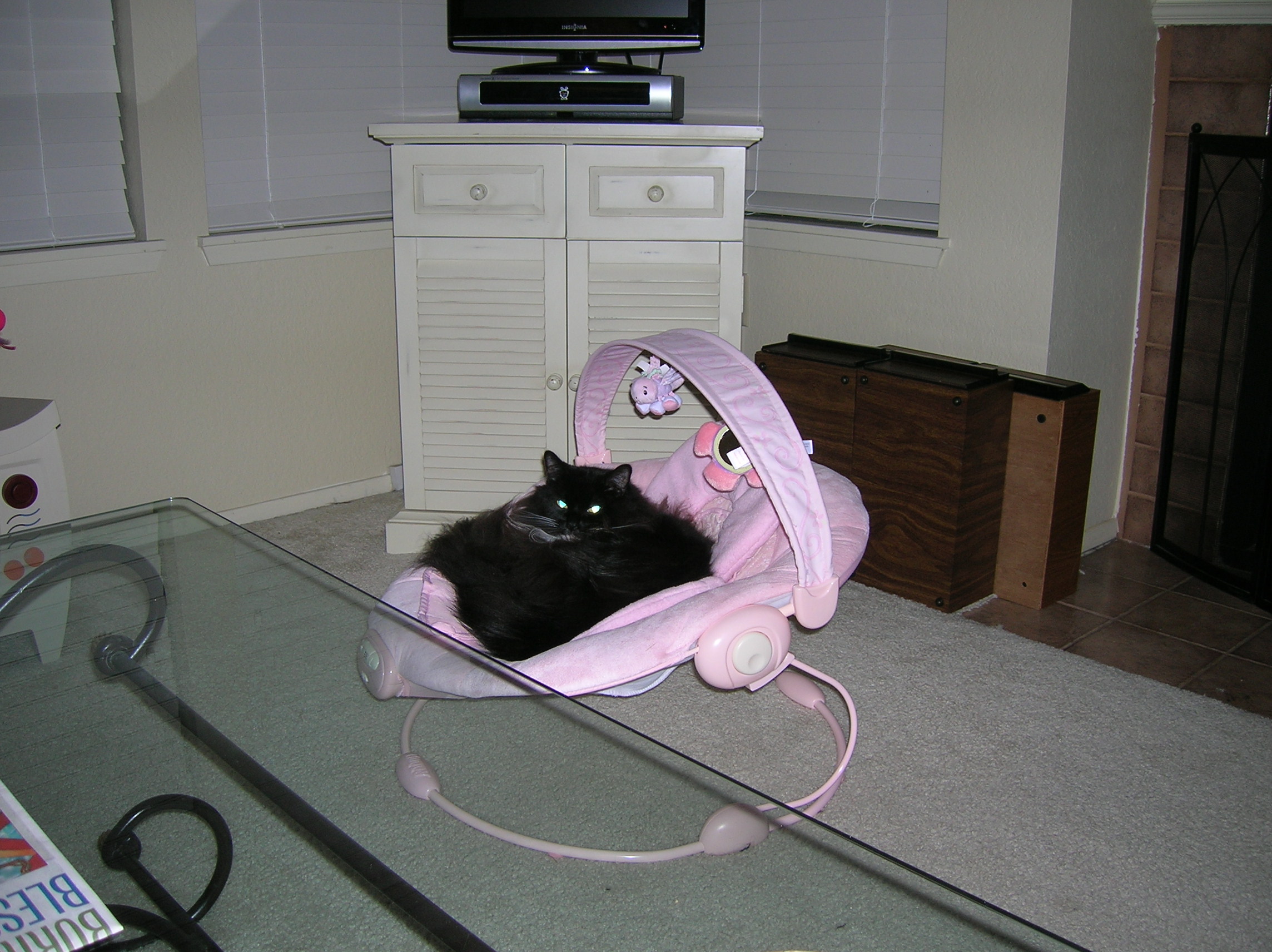 When my daughter was born, Muffin was not immediately aware of the change in the household, but she did like the new “cat bed” in the house. But it didn’t take long for Muffin to become absolutely bonded with my daughter. Any time she would cry, Muffin would run around our feet, as if to say “My gsvirl is in distress! Do Something!” They were inseparable, all Muffin wanted was to be with her girl. During the last summer, between high school and college, they spent a lot of time together, Muffin often sleeping on top of her or right against her. Muffin would spend much of her days sleeping on my daughter’s bed right where she had been sleeping a few hours earlier. After she left for college Muffin rarely slept on her bed, partly because of her artritis, but probably also since the clean bedding no longer had the scent she was seeking.
Did I mention she was kind of scatterbrained? She often didn’t understand three dimensions. Several times she unwittingly walked right past the chair Freya was sitting on, who would bat at her tail. When you called her name, she would look left and right, but not up. This made taking photos of her very hard: she would look everywhere but at the camera. After many attempts we got a good enough shot to use for her to appear in the Purrfect Pals calendar as Miss July (the first photo, above).
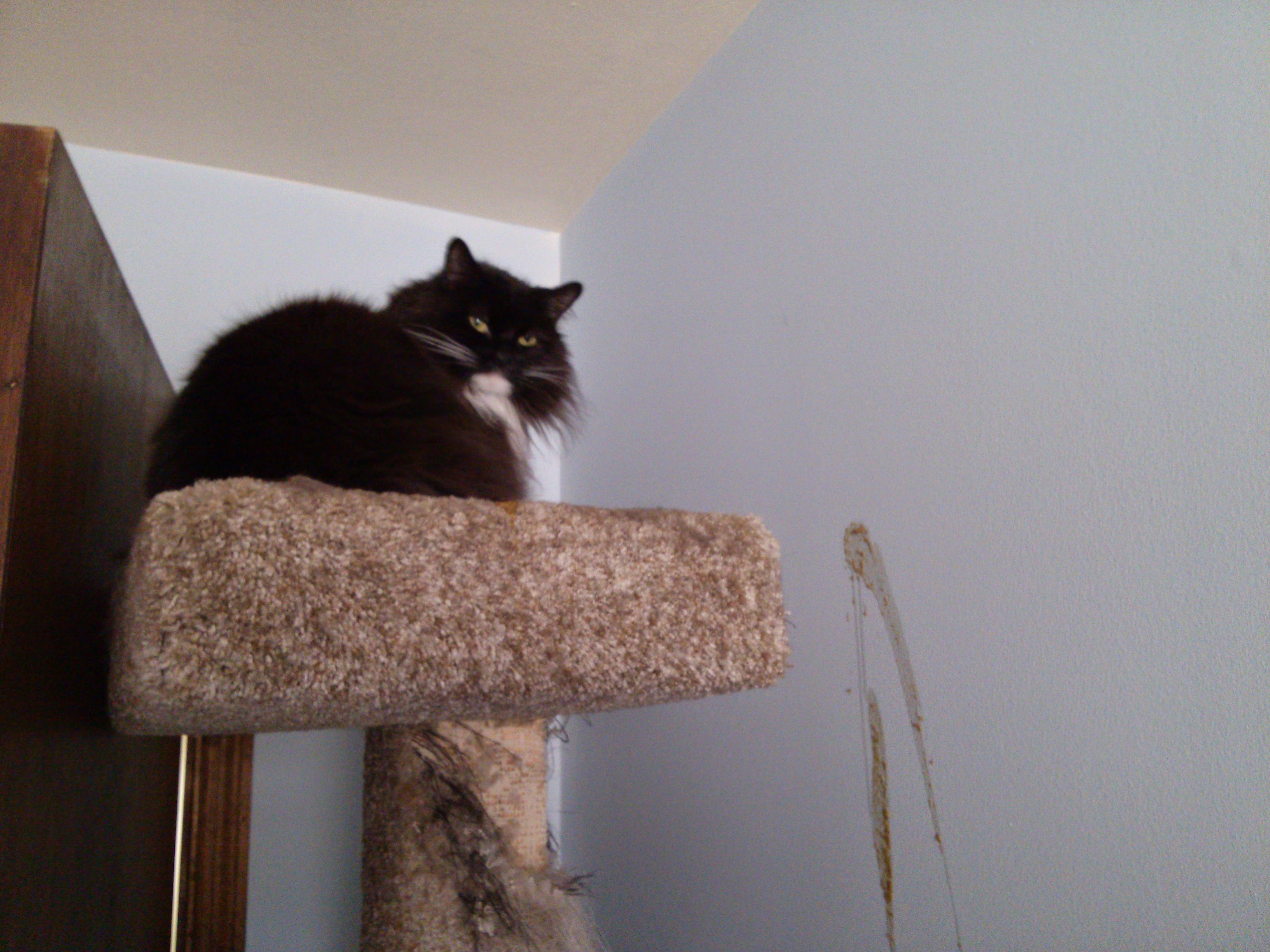 She also had a habit of going into the bathroom where the litter boxes are, and then when she was done, push on the door until she closed it, and then scratch and meow until I let her out. After several rounds of this I found a small board and put it in the way so she couldn’t close the door. Now the same thing happens: push, scratch, meow, and then, after little bit of this, she peers around the corner of the still ajar door, with a surprised look.
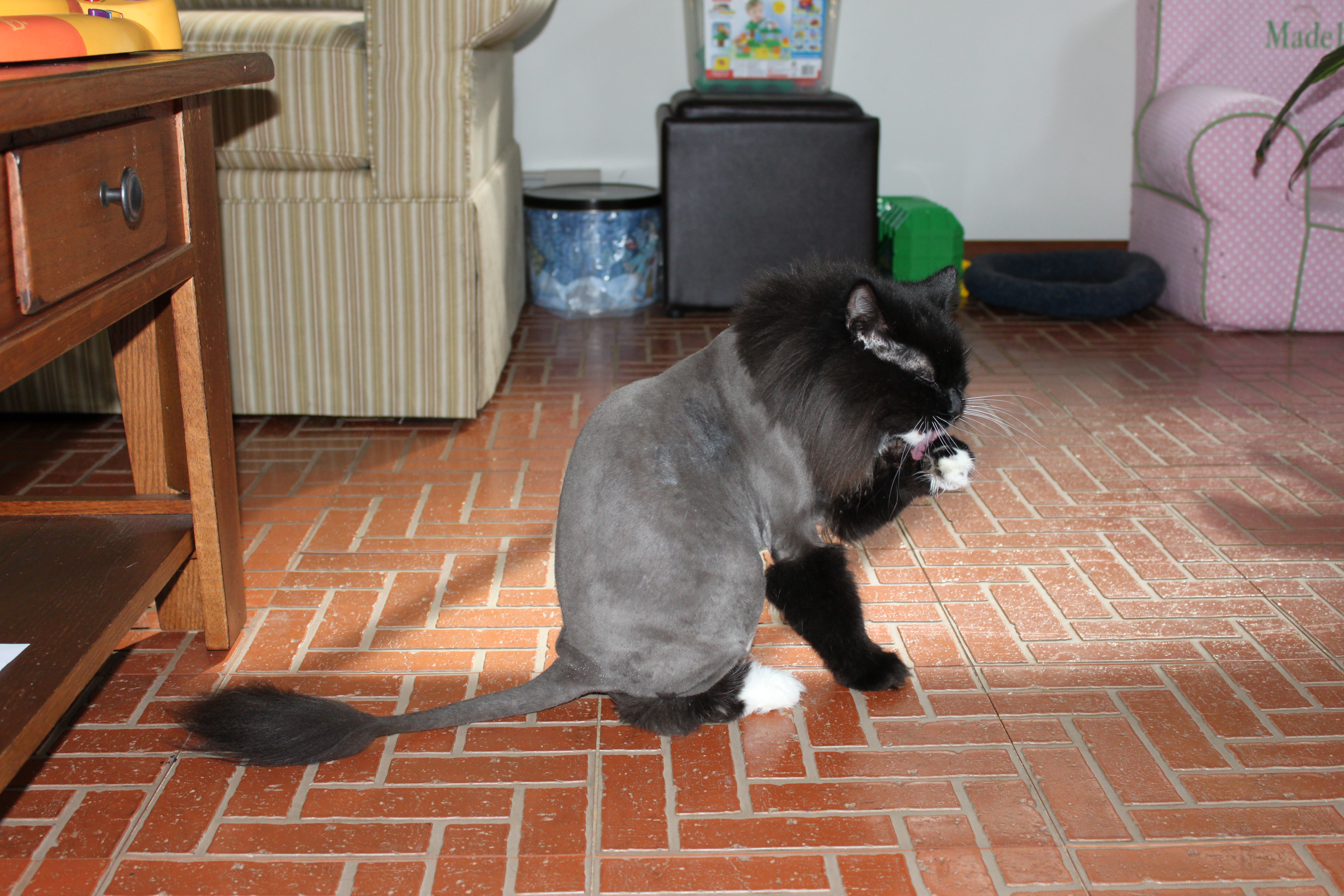 She was definitely not a medium hair cat! That hair was long! In her younger years this made hairballs a frequent and sizable occurence. Sometimes in inconvenient places. Towards the end of her life she had a hard time grooming herself so I would have to brush her in a futile attempt to keep the mats at bay. A couple times we had her shaved for the summer. I am not sure she ever forgave us for this.
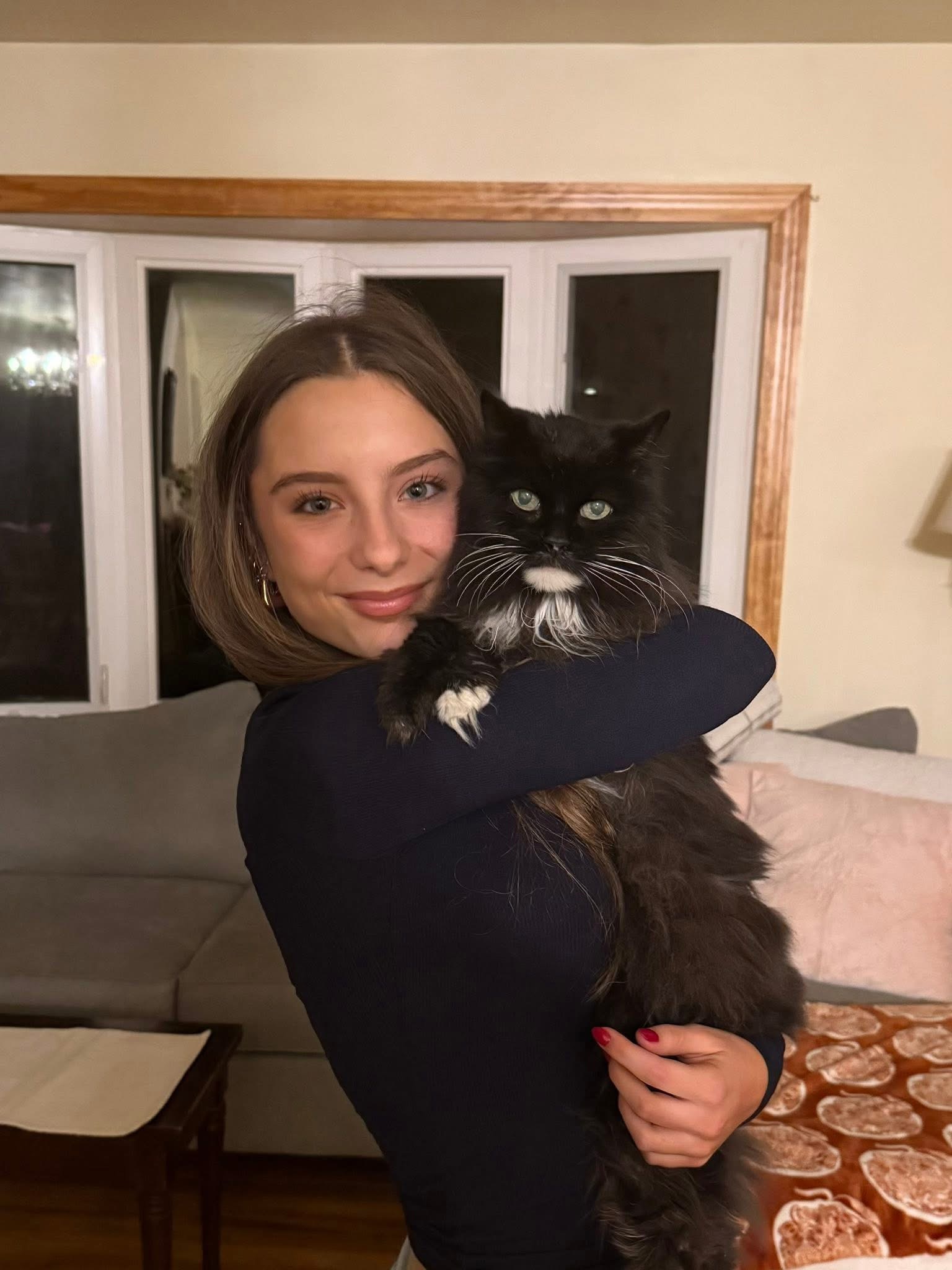 So after Freya passed, Muffin’s arthritis continued a slow progression, but the monthly arthritis treatments definitely helped. On Monday it occured to me that she was due for her next shot and I must have forgotten to schedule it. The vet said I could bring her in later that day. At the appointed time I gathered her up into her carrier, as I had done so many times before. No sign of anything amiss. But as soon as the vet tech got her out of the carrier, she noticed Muffin’s breathing was labored, so after an X-ray and deeper examination, it was found she was in the advanced stages of congestive heart failure. She passed away a few hours later.
She was the sweetest little cat. It’s hard to think of anything she did wrong (yowling in the middle of the night is the worst thing I can think of). She loved her girl to the moon and back again. Now one girl is gone forever and the other is away at college. It’s going to be a lot of emptiness and quiet to get used to.
So here I am after several hours trying to track down why one of my web servers is not working. I am writing this down to vent my spleen. I have complained for years about lousy or nonexistent error messages. It seems that nobody cares, and it will never get better (especially with LLMs mediocre extruded code becoming the norm). Here is my futile scream into the uncaring wilderness.
So here’s the problem: the client is getting an error 500. No further details there. The error_log has nothing at all.
After a while I narrow it down to directories covered by LDAP authentication. Others are fine. I test the LDAP server via the ldapsearch command, it works. Try it with a bind as well, works!
After enabling trace8 output for the ldap libraries:
[Tue Sep 01 23:59:05.524995 2026] [ldap:trace2] [pid 197509:tid 197518] util_ldap.c(649): [client 10.25.132.86:62986] ldap_simple_bind() failed with server down (try 4)
So there is an error occuring, but apparently it was a secret! Only on a need-to-know basis. Wouldn’t want to scare users, you know! So, an LDAP server is returning some sort of error while doing a bind operation. But which LDAP server? What error message? I guess that’s a secret, too? Instead of scared, I am now mad.
I located the source code in Apache (./modules/ldap/util_ldap.c line 648):
        if (AP_LDAP_IS_SERVER_DOWN(rc)) {
             ap_log_rerror(APLOG_MARK, APLOG_TRACE2, 0, r,
                          "ldap_simple_bind() failed with server down "
                          "(try %d)", failures);
        }
That isn’t very enlightening, we still have an error happening a few lines above, but the error message is not part of the secret error message.
A bit more digging gets me to this directive: LDAPLibraryDebug 7
Let’s try it again… After all that we get the actual error message!
TLS trace: SSL_connect:SSLv3/TLS read server certificate request
TLS certificate verification: depth: 1, err: 2, subject: /C=US/O=*****/CN=*****, issuer: /C=US/O=*****/OU=*****/CN=*****
TLS certificate verification: Error, unable to get issuer certificate
TLS trace: SSL3 alert write:fatal:unknown CA
TLS trace: SSL_connect:error in error
TLS: can't connect: error:0A000086:SSL routines::certificate verify failed (unable to get issuer certificate).
[Tue Sep 01 23:59:05.524995 2026] [ldap:trace2] [pid 197509:tid 197518] util_ldap.c(649): [client 10.25.132.86:62986] ldap_simple_bind() failed with server down (try 4)
Now I have something to work with, but why Apache is not using the same CA authorities as the rest of the system is frustrating, but at least I have something I can work with. I hope whoever decided to hide those key error messages is happy with the amount of time I wasted tracking this down.
“When people mix up entomology and etymology, it bugs me in ways I have no words for.”
I have been using Ansible for a number of years. There are a number of things I could critique, but the biggest one is how slow it is. Running a bunch of ssh commands in a for loop would be far faster. Of course, that’s not as robust or flexible, but it is hard to understand why Ansible is so much slower.
I started joking that the word “ansible” is derived from a Latin word meaning “painfully slow”. Making etymology jokes is a sure sign of a nerd, but even more so is digging into the actual etymology. I first thought that it was related to the word runcible from the Edward Lear poem The Owl and the Pussy Cat. While associating Ansible with nonsense was satisfying, it was not true. It only took one more search to find that the word ansible was invented by Ursula Le Guin as the name of a faster-than-light communications device.
That’s some big-league irony! The slowest software on the planet named for a device that is faster than the laws of physics permit; which is, I guess, a nonsense of its own.
I would like to think that both Lear and Le Guin would be offended by being associated with this software. I know I am.
I have been ranting and raving about lousy error messages for a very long time, you can see them all via the errors tag. I used to post details about how the error happend and how useless and/or misleading it was, how much productivity was lost debugging the problem, and the poor programming practices that caused it. But it was sometimes hard to come up with some original snark, but I kept saving the error messages in case something came to mind. But now I have almost 60 of them! I don’t have time to do this; not only do I need to work, but also sleep. Instead I will just collect all my screenshots here, and I’ll keep adding them. That will be enough work.
Since I started doing this 16 years ago, this problem has only gotten exponentially worse, and using LLM slop as code will only accelerate this process. Now, I know I am in a glass house: I have written lot of code and have made some of these mistakes myself and feel ashamed when exposed. But then I go and fix it! If you see yourself in this collection, do likewise!




























































The key to comedy, they say, is timing. The timing of line breaks can also achieve this. I found this in a co-worker’s wiki page:
 ***WARNING***
 grub.conf is the configuration for the "GRand Unified Bootloader"  Screw this
 up, and the machine will need to be reimaged.
 ***WARNING***
I suspect this was intentional given what I know of my co-worker, but since he retired years ago, we may never know for sure.
Side note: Erich Boleyn and I went to college together. We were goofing around with one of the alpha releases of GNU Hurd around 1995. One day he came in and said: “I wrote a new bootloader last night!” That was the beginning of GRUB!
There’s a lot of bad genealogy out there, but this one really infuriated me:
Web Page (Link to the Record) http://web.cecs.pdx.edu/~trent/fam/people.html
Where The Record Is Found (Citation) Digital Family Tree
Describe The Record (Notes) Family Tree of Dan Pidcock. Over 1200 names.
I have no idea who Dan is, or why “1200 names” matters. These are not Pokemon cards!
But here’s the supreme insult: the url above is my own web site! In the 90’s I converted my mother’s GEDCOM file into html and put it on the web. It was crap! There was not a single source citation in there, I know I mixed up births and christenings, dates and numerous other things. That GEDCOM was so bad that it was (wisely) rejected by WeRelate, and I determined that fixing it would take so much work, it was best to start over. So I then entered each person manually, added actual citations, and fixed my stupid mistakes. After that, I removed all the pages under “fam” and changed it to point back to WeRelate, so those pages haven’t been there for well over 10 years.
Update: it just occurred to me who Dan is! I went and looked at the old html files and found this in the footer of every page: “Created by Dan Pidcock’s Gedcom to HTML converter v1.45”. I am no longer infuriated, I am now laughing.
I just happened to see the transcript of the Q4 earnings call for Tesla, and once Elon started speaking I was astounded by his semi-coherence, and this passage, in particular, stood out:
Amazing era of of abundance and and I think with the with the advent with with the continued growth of AI and robotics. I think we actually are headed to a future of universal high income, not universal basic income, but universal high income. I mean, there’s going to be a lot of change along the way, but but that is that is that is what I see as the most likely outcome.
This is interesting from two perspectives:
The first is that the whole “abundance” thing is something the Technocracy movement of the 1930’s was talking about (I wrote about this some time ago, and Elon’s grandfather was a leader in that movement. Of course it turned out later that he was such a rabid racist that he had to move to South Africa. I am reminded of the sticker you see on some Teslas stating that they bought the car before “Elon went crazy”. Both Elon and his grandfather seemed to, initially, promote a utopian vision, but ended up pushing for racism, authoritarianism, and conspiracy theories. Whether either actually changed is up for debate.
The second is that I cannot figure out if he is trying to delude us, or if he is deluding himself. Anybody with an ounce of awareness understands that there is no road from where we are to any sort of universal income, whether high or basic. The current regime is actively working against any sort of “safety net” for non-billionaires. Even in good times we couldn’t agree that nobody deserves to be homeless, starving, and without healthcare.
It is quite possible that his drug-addled brain is so filled with misinterpreted science fiction he somehow thinks that once he replaces all workers with AI, some magic will happen to give everything away to everybody. A sort of missing step plan like:
On the other hand, maybe he is lying with all his might to keep us from noticing how he and his billionaire friends are working hard to establish a techo-feudalist police state.
Or most likely both.
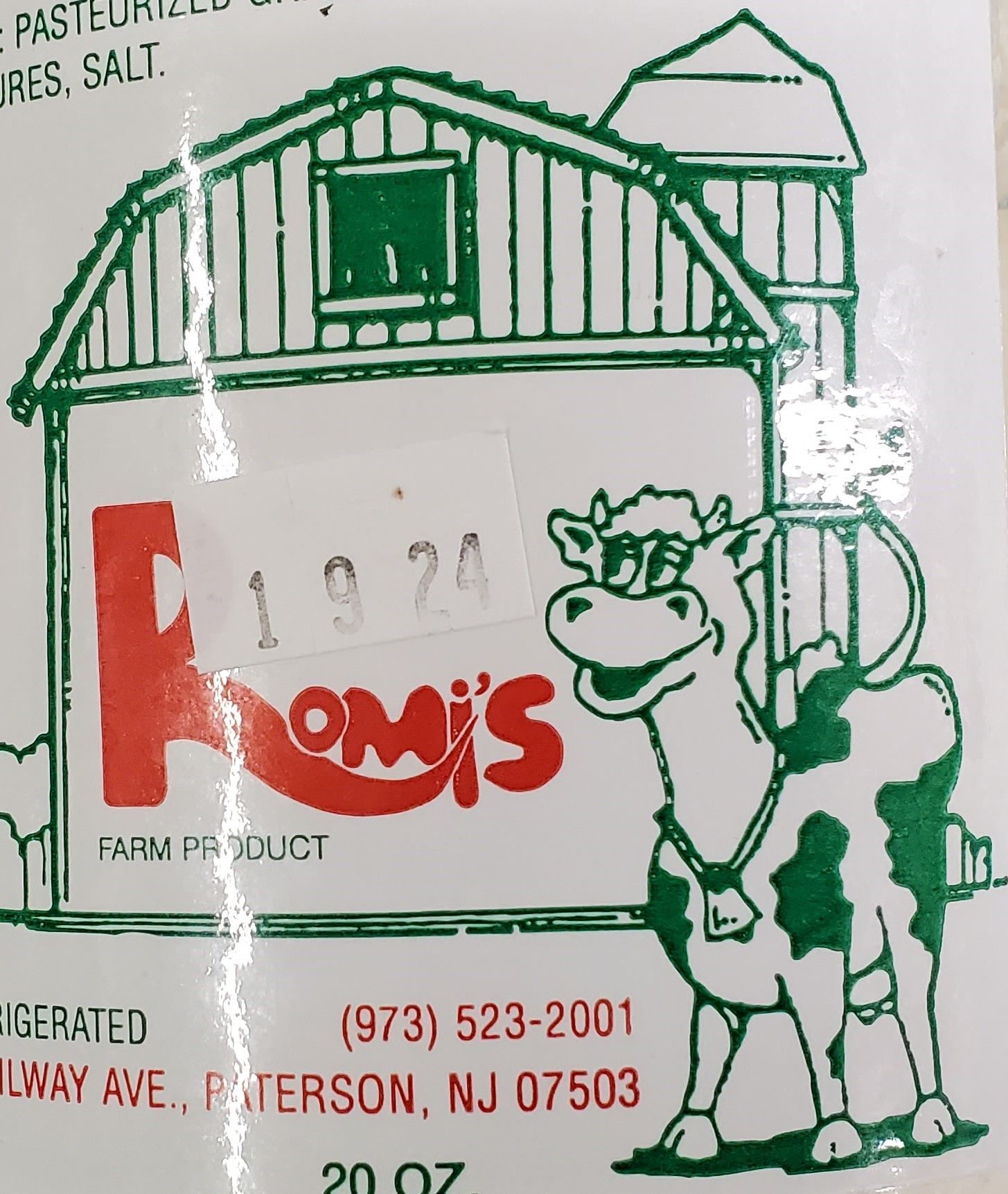
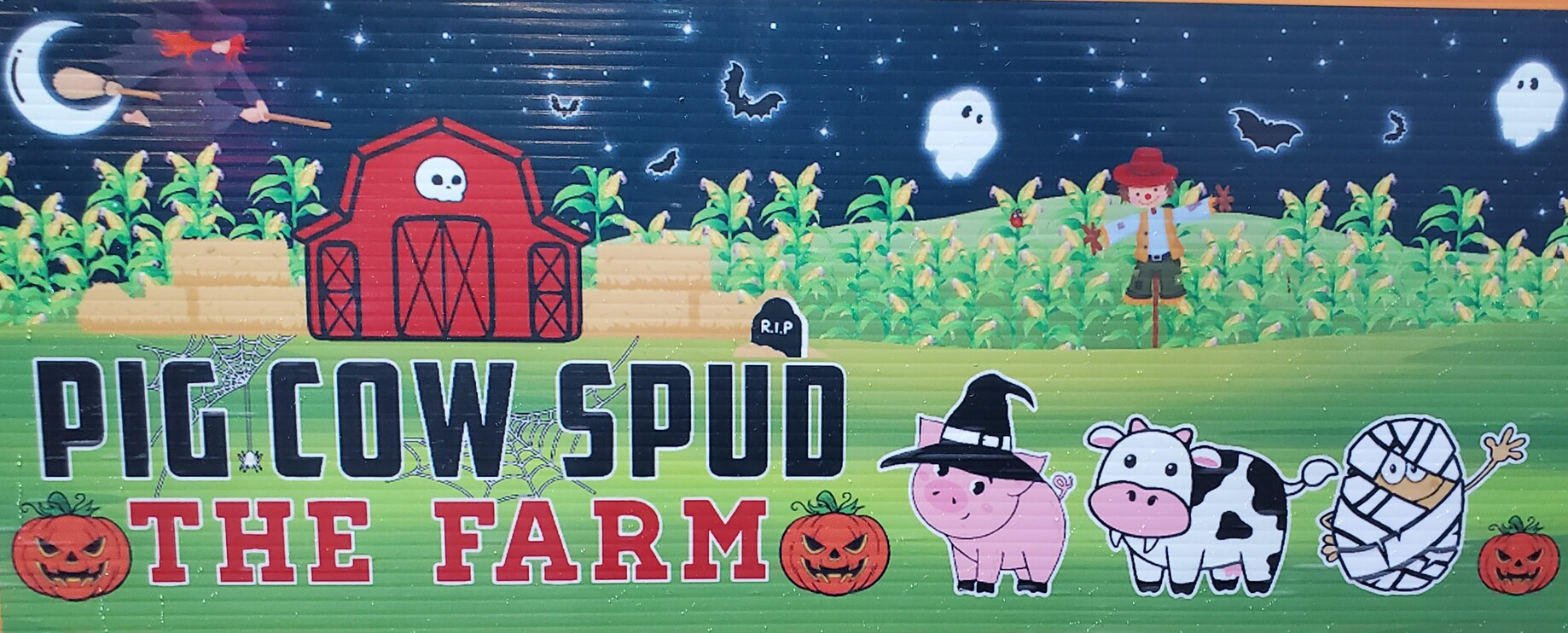
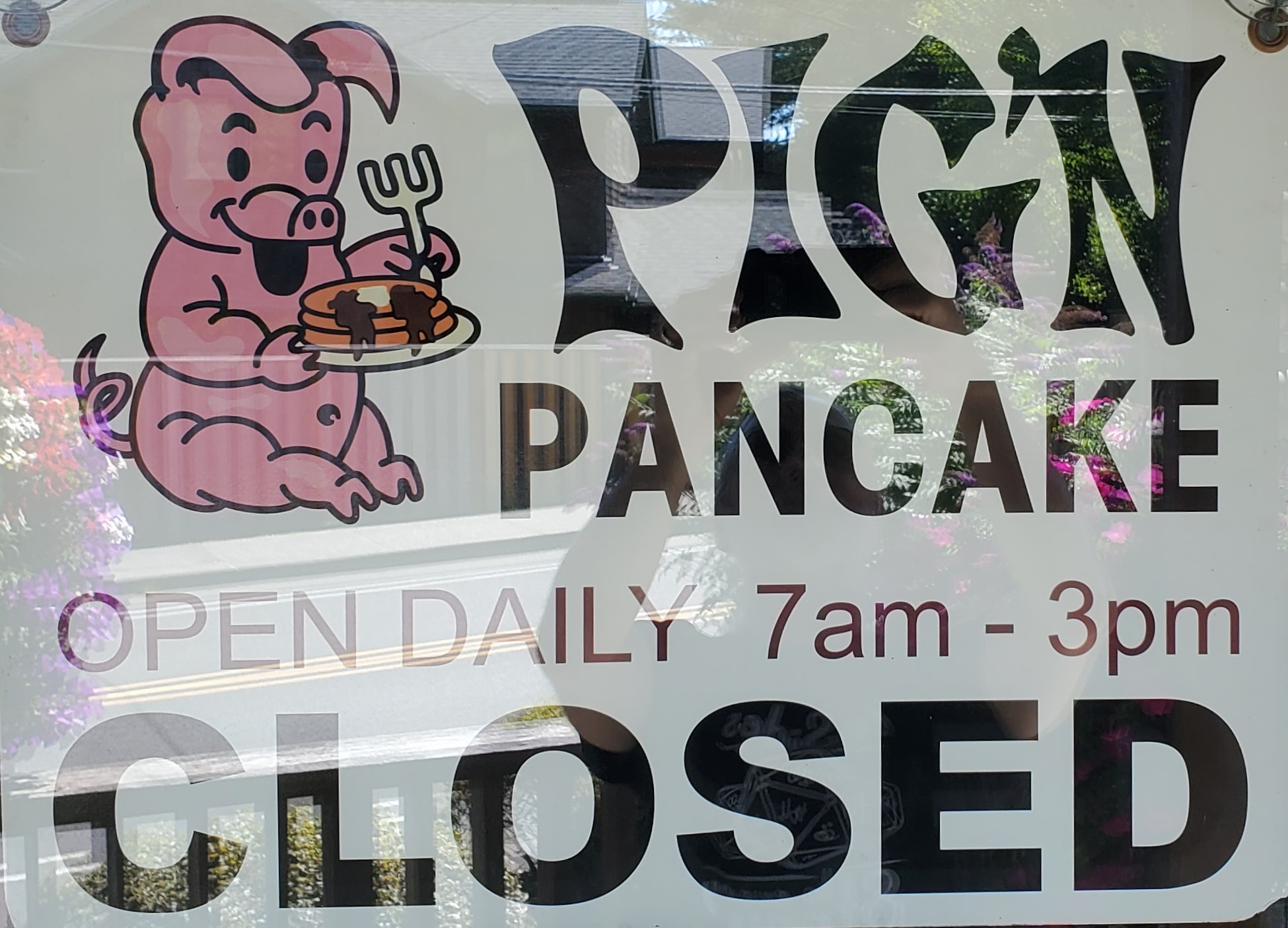
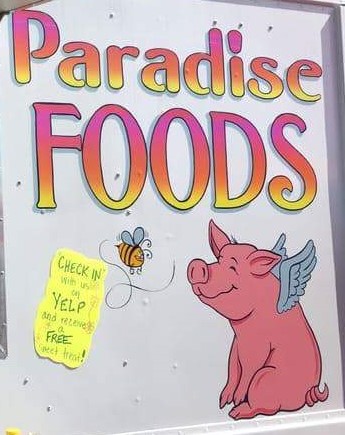
One of my favorite blogs was Suicide Food which ran from 20-Dec-2006 to 27-Dec-2011, and it documented some of the most horrific examples of suicide food.
This is one of those things, that once you are aware of it, you see it everywhere. I submitted a few photos to that blog back in the day, and I kept accumulating photos after the blog’s end. I tried my hand at making similar posts here (see the suicide food tagged posts) but wasn’t able to keep that going. I tried starting up a discussion group on Lemmy but the instance I was on vanished.
So, I figured I should just collect together all the photos I have saved so far, and continue to accumulate them here. The quality of these photos vary, as many of them were taken surreptitiously. So here they are:











































































When I first started using computers, I remember spending lots of time poring over manuals, and finding all the settings and places I could customize my settings. I would change my prompt, add lots of aliases and shortcuts. When the first windowing systems came along (for me it was SunView) I did the same thing. I moved all the icons around, customized the menu and how things worked to suit me. If there was a setting, I goofed with it.
Then SunView was replaced by X Windows (though I think there was a short interlude using MGR), and so I did it all over again. And then the window manager changed, and then I did it all over again. And then another window manager. And there were different window managers on Sun and on Linux, so my work and home systems were different. And then Gnome came out; another radical change. And then I had the misfortune of getting stuck on a Windows desktop. And then it changed. Every time all my customizations would break and I would struggle to figure out how to do the same things in the new system. Over and over.
After a decade or two of this, I just gave up. Just live with the defaults, and make the bare minimum changes you need to get your work done, because the next OS update is going to break them all. Don’t get comfortable as the music may stop at any time. Maybe someday the constant churn of user interfaces will settle on something stable, “but I know engineers, they love to change things”
However, I would like to note two exceptions to this: Bash and Emacs. My startup files for those have code in them that has been there since the days I started using them (circa 1989), both have undergone major changes over the years, but the fundamentals have largely stayed the same, and with them I can be largely comfortable on most any system.
One of the most laughable moments of the Presidential Debate was when Trump asserted that “In Springfield, they’re eating the dogs. The people that came in, they’re eating the cats. They’re eating—they’re eating the pets of the people that live there.”
Anybody with half a brain can see this is an obvious racist hoax and I’m sure you can find many who can pick it apart.
But I want to look at it from another angle, from a vegan’s perspective, in particular, one who follows Gary Francione’s theory of animal rights.
So why is this racist? Obviously it is because only a horrible person would eat a cat, right? Why is it so bad that someone eats cats? Why are cats any different than chickens or pigs or cows or any of the other multitude of animals some of us eat? An adjacent hoax was that they were eating geese; have these people not heard of eating “Christmas Goose”?
There is no moral difference between eating a cat or a cow or a human. None of them want to be eaten, all are sentient and want to avoid pain and continue living. So trying to claim some moral superiority with someone else based on which animals they choose to eat is absurd.
The only way to distinguish between these cases is with speciesism, choosing some arbitrary (and in the end, meaningless) difference and use that to justify different treatment. There is no essential difference between speciesism, racism, or sexism, or any other ism you can think of. Combining the two only makes it worse.
Maybe instead of worrying about imaginary injustices caused by immigrants, you should do something about the real injustice on your plate.
I was chatting with a good friend about the collapse of the stock market on Friday and we were trying to figure out why someone would do this. It is obvious that Trump himself is so addled by narcicism and dementia that he is not likely aware of what he is doing. But I cannot believe that those around him would blindly do something so stupid as to crash the entire economy. That every single one of them could be so deluded, stupid, or, sycophantic. Someone would have tempered what he was doing. Moved the tariff percentages a bit more toward sanity. Or perhaps set a longer timeline. Something.
But then a light went on. I asked my friend “what’s the reverse of pump and dump?” This is the most logical answer. If you know the market is going to crash it is easy to make a lot of money via short sales and timing your buys. And given that you know exactly when the market will be crashing, because you are the one causing the crash, it should be easy to make a killing (ambiguity intentional). Perhaps this strategy should be called “short and crash”. [update: had I read a bit more, I would have known this is already known as short and distort]
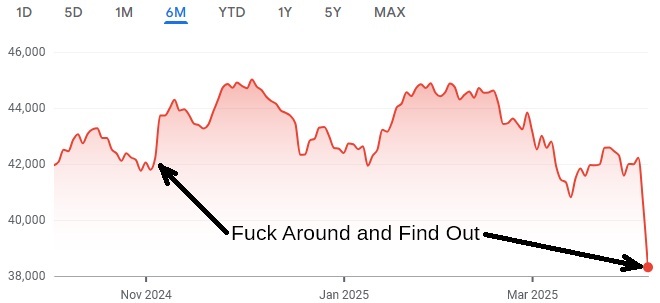
You might think that this is insider trading, but I’m sure the SEC, now that it has been “updated” by DOGE, will correct our misconceptions. Or, at least, remain silent.
I have done no investigation into this, and it may be that nobody in the administration thought such a crash would happen; and perhaps none of them participated in widespread short sales; and it may be that the SEC has not had key enforcement personnel removed from their positions. But it is inconceivable that an administration packed to the gills with grifters and opportunists would not have taken advantage of this situation in any way whatsoever. We will likely not know for many years.
TL;DR: I listen to podcasts. A lot of them. Perhaps too many. There is a list below of my favorites. You can look at the list rather than reading my rambling introduction, I guess.
So it was 1993, the internet was a blossoming place. The world wide web was rapidly gaining over a variety of other services. I think it was an O’Rielly newsletter which pointed out the first episode of Internet Talk Radio. One of my friends had the task of downloading the audio file, which took hours, and we sat around his computer listening to it. Being that cumbersome I don’t think I ever listened to any other subsequent shows.
At one point in my life I started noticing my habbit of turning on the TV as soon as I got home from work, and it was on until I went to bed. When I was moving in the year 2000, I decided to drop that habit and since my TV was missing its antenna all I had to do was drop cable to break that habit. I replaced that habit with turning on the radio (NPR) as soon as I got home. But that was an improvement, since audio does not hinder me from doing other things around the house.
Some radio stations were starting to stream onto the internet, so I was able to follow some shows, notably Go Vegan Radio. I think it was 2003 when I heard about Cristopher Lydon’s show The Whole Wide World. Apparently this show was was the reason RSS added the ability to include audio files, which was the birth of podcasting. Though, as is often the case with me, I failed to notice the significance for several years
Sometime around 2006, after a concert of the band “Fruit”, I went to get a CD and one of the band members saw my vegan tshirt and suggested I read Peter Singer. That triggered a memory and when I got home I looked for interviews with Gary Francione. I knew that my wife had listened to an NPR interview with him which inspired her to become vegan, and I suspect I remembered him critiquing Singer. I found the Veganfreak podcast’s interview with him, and I listened to that podcast regularily as long as it ran. I think this marks the start of me actively seeking out and regularly listening to podcasts, but with several different software packages, but after I got an Android phone I settled on AntennaPod.
So, what follows are the podcasts you must listen to (this list is going to grow over time, stay tuned):
| podcast | when | notes |
|---|---|---|
| 13 Minutes to the Moon | 2019-2021 | Excellent documentary about Apollo 11 and Apollo 13. Soundtrack by Hans Zimmer. |
| Death in Ice Valley | 2018-2021 | An engrossing podcast about a mysterious death in 1970 |
| Dungeons of Drakkenheim | 2019- | One of my favorite actual play D&D podcasts. I am running two campaigns based on this setting. |
| GM Word of the Week | 2015-2023 | A far-ranging podcast which starts with D&D terminology and covers history, mythology, and most anything else even vaguely related. I can (and do) listen to this over and over again. |
| If Books Could Kill | 2022- | You know that odious bestseller self-help book? These guys will rip it apart. |
| More or Less: Behind the Stats | A refuge from misinformation, I found it during the pandemic and it help maintain my sanity amongst all the misinformation. | |
| Podcast Party | 2020- | A great D&D actual play podcast, well produced, well acted. |
| Satanic Panic | 2020? | I have long had a fascination with the Satanic Panic and this covers a particulary alarming case of lives being destroyed as a result. |
| The Bomb | 2020- | A deep dive into two different people involved in the development of the atomic bomb. |
| The Bunker | 2020- | I discovered this (and several spin-off shows) at the beginning of the pandemic, and it helped me maintain my sanity during recent events. |
| The Constant: A History of Getting Things Wrong | 2017- | Fascinating tales of historical screw-ups. The patreon feed is well worth it! |
| The Lazy RPG Podcast | 2017- | The best podcast about D&D |
| Uncivil | 2017 | An excellent podcast about the Civil War. Sadly it came to an abrupt end, I am sure they had more stories to share. |
| Unobscured (first season) | 2018 | The first season is a detailed account of the Salem Witch Trials. |
I surrender. Last weekend I was looking at the decaying remnants of my garden, and then I went and tore it all out. The deer fencing, the trellises, the decaying and collapsing boards around the raised beds, the dead weeds and such from last year’s neglect. That was probably the first time I went out there in years. But now it is gone.
I spent my younger years on a small farm. My mother had a large garden, but I never really paid attention. I always had my nose in a book, or, in my teenage years, in front of a computer keyboard. I went off to college, moved to the city, and forgot about it. When I bought a house I briefly got a garden going, inspired by Eugene Coleman’s gardening TV show (back when the Discovery channel had good shows). I got a good crop of tomatoes, but between work demands and a failing marriage, that fell by the wayside. The house was sold and I spend several years moving around the country, forgetting many things: the garden, old friends, my boat, etc.
After my daughter was born it was time to settle down and buy a house. This time I had a significant amount of land and I had grand plans. But no grand results were forthcoming.
For every action there is an equal and opposite rebuke. Though with my garden it was not a proportional response, almost everything I tried was met with stunning defeat. Defeat after defeat.
Lack of sunlight is a problem, while I own half an acre, it is populated with 46 trees, many of them quite large, such that no spot in the yard gets more than a few hours of direct sunlight. It became obvious that removing trees would only partly help, as the western side of my yard borders on woods. So increasing sunlight would have required the removal of dozens of trees, many of which I don’t own.
I probably should have stopped there, but I decided to marshall ahead.
My first near-harvest, was a small eggplant. My wife saw it while she was in the house, and decided to go and pick it. As she is headed that way, she looks back out at the garden and sees a squirrel running across the yard with that eggplant in his mouth. The tomatoes next to it got partly eaten my hornworms. And the poison ivy, which is endemic here, grew up through my sheet mulch and ended up being pulled with some weeds, leading to a nasty rash.
So larger beds, more compost, in a different location. But the deer like to sample, so I built a fence. And the squirrels and woodchucks liked the looks of those pinkish tomatoes, and would try a bite: “Ew! That’s awful, let’s try the next one…” and so on. Most tomatoes that grew within a foot or two of the ground would look tempting, but when picked had a big rotten hole in the bottom of them.
Both the tomatoes and cucumbers spend the summer in a race against the various sorts of fungus and blight consuming their lower leaves, and before the end of the season the whole plants would wither, struggling to produce a few fruits. I tried zucchini several times which generally resulted in no female flowers (and, thus, no fruit) or the leaves consumed by fungus, or both.
Years ago I got a bunch of asparagus roots and planted an 8 foot row down the middle of one of the beds, that row slowly shortened, fewer and fewer shoots coming up each year, until now it seems to be a single plant, which produced a couple of shoots last year.
I have generally been a fan of no-till gardening and started most of my beds by sheet mulching: laying down a layer of cardboard and then piling leaf mulch and compost on top of it. One time I decided I should try double digging a bed. Every single time I put the shovel in the ground there was the “clunk” of a stone. I slowly got the digging done, pulling out so many stones, that, even after adding all the compost I had, I ended up with a sunken bed instead of a raised bed. Though this is no surprise given the geology of this place: The entire state was scraped clean through every ice age. There is only a thin layer of soil on top of stone.
So I constructed my beds, filled them with compost mostly from the leaves which fall every year. Nice loose soil to plant my seedlings in. But when it came to plant in those beds the next year, I found digging holes difficult, for all the roots spread through the beds. As I dug I pulled out numerous clumps of roots. At first I thought it was the leftover roots from last years plants, but I came to realize where those roots lead, as I look up at the numerous trees surrounding my yard. I am sure the majestic maples high overhead are sending their roots far and wide in the thin soil to find nourishment, and those compost-filled raised beds are pretty tasty. The seedlings in those beds end up losing out to these neighborhood bullies, coming by and stealing their lunch money (and lunch).
Maybe I should try some more shade tolerant plants, maybe some brassicas. What I quickly discovered was that cabbage worms are everywhere, and will swiftly devour the entire plant. Given the legions of caterpillars, once the eggs are laid on the plant, the battle is lost. I tried row covers, but either I did not put them on at the right times or didn’t seal them up well enough. But even the plants that I did manage to get to maturity were scrawny things due to what I mentioned above.
I also tried growing lettuce, often in containers, but that can be a feat as the climate here seems uniquely suited to causing plants to bolt, sometimes to the point that flowers are forming before there are many leaves at all. I can certainly understand that, because spring usually only lasts a week or so here. It is usually a week where I start out wearing sweaters due to the freezing cold, and by the end of the week I am wearing shorts and putting in the air conditioners to tame the stifling heat.
Planting new seedlings was always an adventure. Besides the problem with all the roots in the bed that I mentioned earlier, squirrels are drawn to new plantings, and usually at least one plant will be dug out of the bed by the next morning, if I am lucky it is intact enough to replant. Apparently they do not realize that if they just waited a few months there would be small fruits which they could chew on or run off with (as they often do). One time I planted out my new seedlings, and as I was finishing the sky grew dark and it started raining, a total downpour. When I came out afterwards to check on the garden, I found all my seedlings were gone, pounded into oblivion.
I grew saffron for a couple of years, but digging up the bulbs is a challenge with all the roots to dig around, the last time I did so I found most of the bulbs dug up and/or eaten. It may not have been the squirrels, but with all the other damage they cause, I am not giving them the benefit of the doubt.
So the plants face quite a range of challenges, what about me? For most of the growing season it is very hot and humid, things that insects like. The mosquitos were relentless. So were the ticks (deer ticks with lyme disease, no less). I was bitten repeatedly despite bug spray, BTI laced traps, etc. Oh, and the poison ivy, which grows everywhere. The only thing left was a mechanical barrier. So I would have to wear jeans and long sleeve shirt, regardless of the weather and always plan to shower immediately afterwards. Tending to the garden was a time consuming ordeal, and, as such, didn’t happen as often as it should.
Can I say anything positive? I see many gardeners complaining about “weed pressure”, but weeds rarely caused me a problem. I suspect the weeds were smart enough not to grow in such an inhospitable place. And water was rarely an issue, usually it rained frequently enough so that I didn’t need to put extra water on the garden, but on the other hand, I think all this rain and lack of sunlight exacerbated the fungal diseases.
Let’s review: lack of sunlight, fungal diseases, insect pests, squirrels, woodchucks, deer, mosquitoes, ticks, tree roots, thin soil, horrible weather. The deck is stacked against me. I surrender.
Anybody who knows me, knows that I have tasten which run towards that which is obscure, unpopular, or simply forgotten. This is particularily true of music. In the late ’80s I discovered Phil Ochs and was so taken with his work that I created a web site as tribute to him.
One day (again, in the late ’80s) I spotted a small write up about a local band called The Riflebirds and that they were playing at the Dublin Pub. I was getting together with a bunch of friends and I talked them into going there for the next show. I was immediately taken with the band, and went out to buy their new album.
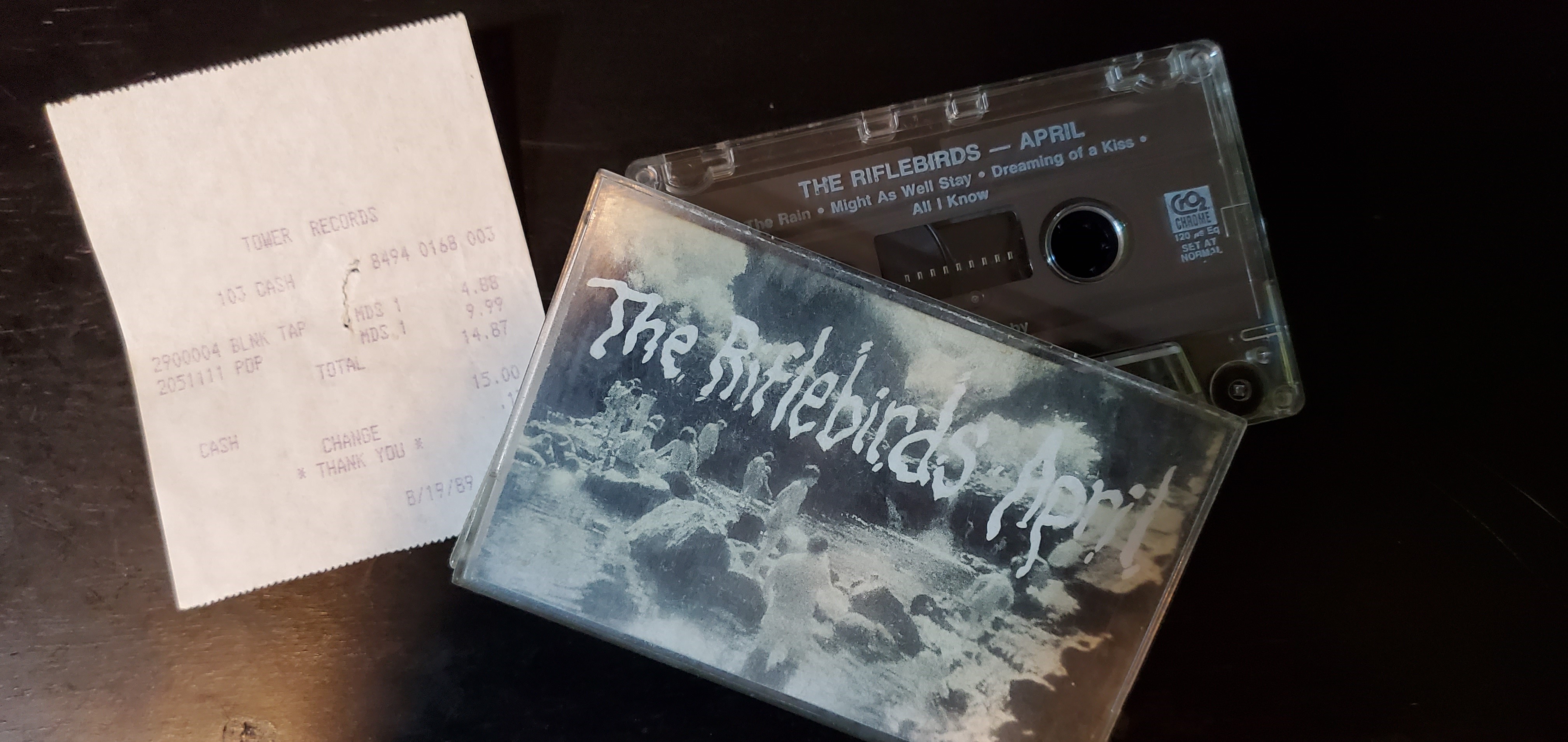
Sadly, the band broke up shortly afterwards. I think I went to their final show a few months later.
But I still listened to the tape, and had it sitting on my desk at work at the university.
One day a student came in and wanted to transfer his files onto floppies to take with him. My office mate was helping him do this and at one point the student saw the tape and asked “is this yours?” My office mate did not share my taste in music and, with a sneer, pointed at me and accusingly said, “No, it’s his”. The student then revealed that he was Kevin Kraft, the guitarist for The Riflebirds. We chatted for a bit, but I don’t know why I didn’t have him autograph my tape.
Many years later, I was at a John Wesley Harding concert in Seattle. When he introduced the band members I heard a name that rang a bell. After the concert, while getting a CD autographed, I asked the drummer if he was the same Kevin Jarvis who played with the Riflebirds. He seemed shocked that anybody remembered that.
But the tape has stayed in my collection, and periodically I would listen to it, and wonder what might have been.
One day, years ago, I searched for them on the web, which was a bit tricky as an Austrailian band by the same name started around 2014. And there it was! There were a few songs on ReverbNation including an extended version of their masterpiece “The Rain”. I absolutely love that song and now that I live far from Oregon it makes me miss both the band and my home state. I managed to (badly) digitize the tape so now I have it all on my phone. But I always wish I had more.
However, last week I get an email that they released a single, Sometime Somewhere (more versions at bandcamp) and an album will follow! This is the best news I have gotten for a long time! Go check them out!
I discovered that their new track is on Amazon music, and they force you to their shitty shuffle (I am writing up something about that) but in this case, after playing the Riflebirds it played Dar William’s song “As Cool As I Am” which was quite a coincidence, as I always thought Dar should do a cover of “The Rain”.
[Note: I had this article mostly written years ago, but never could think how to bring it to a close. But the band fixed that for me!]
Even though I was always interested in science fiction, I really never read very widely. I honestly cannot think of anything I read which was not connected to a TV show or movie (e.g. Star Trek, 2001, Hitchhikers Guide). After I started playing D&D I veered off into fantasy, which was most of my fiction reading for many years. As I have gotten older I have found that my diet of mainly non-fiction books was hard to maintain, so I now always try to have two books in progress: one non-fiction, and one fiction, when I get tired of reading the former, I will read the latter. This is a good strategy and has increased how many books I am able to get through. As such I have started reading older classic science fiction, many from Appendix N.
I don’t remember how, but a few years ago I happened upon the works of Clifford Simak. I read The Way Station and really liked it. It felt different from so much science fiction, it had a meditative pace and focused on the characters rather than on gadgets and guns. It was a beautiful story and I felt better having read it.
 As I was looking through his other books I noticed The Goblin Reservation and that name rang a bell. I know I saw that name before. Then I remembered…
The first time I played D&D the DM put the giant map of the City State of the Invincible Overlord onto the table. That map was full of delicious details, and I wanted to be there. At that moment I was hooked on D&D. I studied every detail on that map, so, even after all these years, I remembered an odd detail: the area on the map labeled “goblin reservation”. Given that Simak’s book was published 8 years earlier, this cannot be a coincidence, I suspect that is an “Easter egg” and a homage to Simak. If anyone has any evidence to back up this conjecture, I am all ears.
I have just finished the book and it was a fun read. Simak clearly did not believe in the division between science fiction and fantasy, and he gleefully mixed them all up, but somehow still kept it a believable, compelling story. This mashup reminded me of some D&D adventures with similar genre jumbles, like the classic Expedition to the Barrier Peaks or some Judges Guild adventures.
Yet another coincidence is that Simak was born the same year as my grandmother, and both of them had fathers who emigrated from Bohemia. Further, he was born and raised in the same county where my grandmother also spent her early years (from 1910 to 1926) about 30 miles away from each other. Furthermore, when I saw his photo on Wikipedia, I was immediately saw a resemblance to my uncles on the Czech side of the family. But on the other hand, his mother descends from early settlers in New England, and it appears we are 9th cousins, maybe less. In the course of finding that, I noticed that one of his great uncles lived in Lake Geneva, WI.
So for all these reasons, I feel an odd connection with Simak, and his works will be on my to read list for some time. Let me know what I should read next.
Some time ago I had a long discussion with my father (someone who has a long history with cars starting with riding his father’s new Ford Model A) about the prospect of autonomous cars. I don’t have any particular knowledge on the topic, beyond working in an unrelated specialty of computer science. Though I do have experience being hit by a car. And I got a “C” in high-school auto shop class. So take everything I say with appropriate grains of salt.
I started out arguing that having a computer drive a car was a hopeless task. Think about what we have to do every time we drive: we have a multitude of different controls; we have to monitor other cars, pedestrians, bikes, animals, all moving in every direction; we have to monitor our location in the road and understand all the markings and signs to know where to go next. I am teaching my teenage daughter to drive, and I find more and more things to explain to her. There’s a reason we require them to practice with an adult in the car for quite a while before they can do this on their own.
Furthermore, I don’t have faith that we could even write software reliable enough to do all this. I have written about the sad state of software on this blog for many years. We all have to deal with lousy software every day. It should be self-evident that this is a problem.
Midway through this discussion I had a sudden realization: Humans are really awful at driving. I mean, really awful! We accept the fact that the most likely way for our children to die is due to a car. We just accept that cars will kill 40,000 each year (in the U.S.). The computer doesn’t have to be a perfect driver, just better than humans. The computer has a VERY low bar to clear. A computer isn’t going to drive drunk, or text while driving, or get road rage, or drive too fast on icy roads, etc. A computer may fail to notice a stop sign, or not notice the bicycle in the next lane, but humans do that ALL THE TIME!
Should we be terrified of getting into a autonomous car? Sure. Should we should also be terrified of getting in a car with Aunt Mildred? Absolutely! Or be afraid trying to walk across the street? Damn right!
The fundamental problem is that you have a ton of steel moving at high speeds to carry your (comparatively) tiny body from one place to another. It’s a waste of materials, resources, and lives, no matter who’s driving.
I think we have all heard the old story: A man asks a woman if she will sleep with him for a million dollars. Of course, she says yes. He then offers her two dollars and she gets mad, saying, ‘What do you think I am?’ He answers, ‘We know what you are. We are just haggling over the price.’
I think most people would agree that killing Hitler (or anybody else who has killed millions of people) would be justified. And, conversely, most of us would agree that killing someone who has done no harm to anybody is utterly unacceptable (though I can think of some police officers who would disagree).
So we know what sort of people we are, we’re just haggling over the price. How many people does one have to kill in order to justify killing someone? Was Brian Thompson responsible for enough deaths to justify his killing?
My answer is, of course, “no”. But for two reasons. First is that I decry any sort of violence and killing. I am vegan, so I am opposed to harm to any animal, not just humans. (People love to ask vegans silly hypotheticals, if you are tempted, go read some Gary Francione instead)
Secondly is the same reason I oppose the death penalty: Assuming they are guilty of the crime (which is sometimes not the case in this country) it is the easy way out for them, they will suffer for a few moments and then they are free of any consequence for what they did. But the victims and those they knew will continue to suffer for years. So I want the perpetrator to actually pay a penalty comensurate with the crime, to have to live in a tiny concrete room for the rest of their days, constantly reminded of what they have done.
Brian Thompson should not be dead. He should be in jail and stripped of his assets. Let him experience the medical bankruptly he inflicted. Let him put up a GoFundMe for his medical expenses. Maybe he should be forced to spend all his days on the phone with health insurance companies appealing claims denials. That would be a suitable community service for him.
However, thinking about all these denied insurance claims brings me back to the debate about Obamacare. I was particulary amused by the “death panel” myth. Amused? Yes, because we already have death panels! They are called health insurance companies. Their claims denials, for some, lead to death.
Assuming such decisions have to be made, I would prefer it to be made by a government agency. At least we have a nominal amount of control and accountability with such an agency via the ballot box and such. A private health insurance company has no accountability and no appeals; its sole purpose is to maximize profits, which logically, inevitably, leads to claims denials. The more the better.
I guess we can bring the claims denials back to that old joke (especially since I am not really qualified to discuss the nuance of this topic). Is 48.3 million denials (that’s 17%) too many? Is one? We’re just haggling over the price.
I would suggest reading Cory Doctorow’s post Predicting the Present. He is a much better writer.